

Estimate Land Value With Our Free Land Value Calculator
If you came here wondering, “How much is my land worth?” and you’re looking for a quick answer, you can use our interactive free land value estimator below. Pick your state, county, and acreage to get an estimated range based on 2025 USDA data. The state with the cheapest average price per acre for land is New Mexico at $725 per acre, with Rhode Island having the highest price per acre at a whopping $22,500 an acre.
Tell us more about your land to narrow the range.
Your estimate is a starting point. Get a personalized report with county-level data and value factors — free, delivered to your email.
We're putting together your personalized County Land Value Report. You'll receive it by email once it's ready.
For further information, please see our Privacy Policy.
How to Use This Land Value Calculator
- Select your state
- Select your county
- Enter your acreage
- Review your estimated land value range
- If you want a more exact value, submit your property details for a closer review
How Does a Land Value Estimator Determine My Land’s Value?
A good online land value calculator works best when it uses data tied to your local area, not broad national averages. If you own land in Idaho, you do not want your estimate based on what large ranches in Texas sold for last year.
This free land value calculator uses USDA survey data broken down to the county level and adjusts for parcel size. That matters because the price per acre on a 5-acre parcel is often very different from the price per acre on 200 acres.
It is not a replacement for a professional appraisal, but it gives you a strong starting point for understanding your land’s value before you look at comps, speak with a buyer, or request a more exact review.
How Recent Land Value Trends May Affect Your Estimate
Land values have increased significantly over the last five years, which is one reason older comps and outdated assumptions can miss the mark. According to USDA data, the national average for farm real estate rose from $3,330 per acre in 2021 to $4,350 per acre in 2025. Cropland increased from $4,350 to $5,830 per acre, while pasture rose from $1,470 to $1,920.
That does not mean every parcel increased at the same rate, but it does show why current data matters when estimating land value. If you are trying to figure out what your land is worth today, it is important to use recent county-level data and compare it with current nearby listings and sales.
| Year | Farm Real Estate ($/acre) | Cropland ($/acre) | Pasture ($/acre) |
|---|---|---|---|
| 2021 | $3,330 | $4,350 | $1,470 |
| 2022 | $3,720 | $4,940 | $1,630 |
| 2023 | $3,970 | $5,320 | $1,740 |
| 2024 | $4,170 | $5,570 | $1,830 |
| 2025 | $4,350 | $5,830 | $1,920 |
Land Values by State: Interactive Map
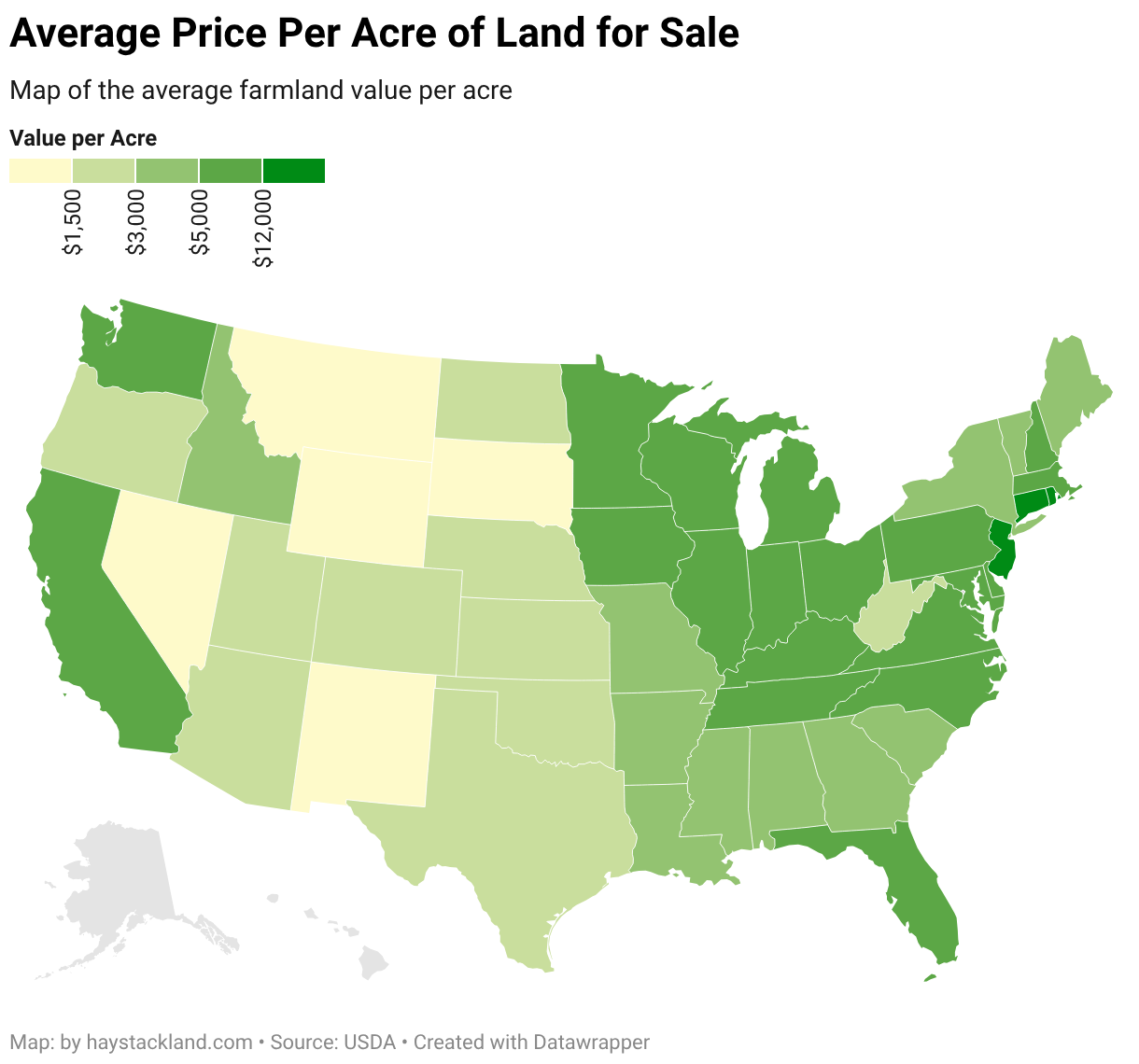
Which States Had the Biggest Land Value Increases in 2025?
Growth isn’t spread evenly. Six states posted increases above 6% in a single year, well ahead of the 4.3% national average.
| Rank | State | 2025 Value ($/acre) | YoY Increase |
|---|---|---|---|
| 1 | Michigan | $6,800 | +7.8% |
| 2 | Tennessee | $6,150 | +7.7% |
| 3 | South Dakota | $2,970 | +6.8% |
| 4 | Ohio | $9,350 | +6.7% |
| 5 | Texas | $2,970 | +6.1% |
| 6 | Utah | $3,500 | +6.1% |
| 7 | Oklahoma | $2,540 | +5.8% |
Own land in one of these states? Your property could be worth more than you think. We’ll give you a free cash offer so you know exactly where you stand.
Factors that influence land prices and acre value
What’s my land worth? Important factors to consider when evaluating the price of your land include:
- Location
- Road access
- Topography
- Surrounding wetlands, floodplains, and flood zones
- Utilities (power, water, sewer)
- Type of land and land use
- Local market trends
- Special features
- Recent sales that match your property’s characteristics
Let’s look at each of these factors in more detail, as each of them can greatly affect the value of your land.
Location
The location of your land is likely the most influential factor, as each state in the United States has vastly different land prices. Make sure to check the map above to get a general idea of how much land costs per acre in your state.
While the state obviously has a significant impact on land valuation, so does the proximity to a city or other types of development. Urban and suburban land typically commands premium prices, while rural parcels further from development sell for less per acre.
Road access
The more public road frontage your land has, the more value it adds. If you can’t easily access your land, it will be worth less. Land only accessible via a right of way or easement requiring a 4×4 or ATV will have reduced value.
If your land is “landlocked,” having no legal road access of any kind, it could be worth as little as 25% of the value it would have with public road frontage. Many states have laws enabling landowners to obtain an “easement of necessity” through the courts to access landlocked property.
Topography
Land with boulders and significant slope.
Land topography refers to the slope and contours of your property. While some slope can add visual interest and habitat diversity, steep terrain significantly reduces land value due to increased building costs.
Land slope is measured as grade: the vertical distance (rise) divided by the horizontal distance (run). Here’s how slope affects value:
- Under 5% slope: Ideal for building, minimal impact on value
- 5-10% slope: Minor value reduction, some contour can be beneficial
- 10-20% slope: Moderate slope where building costs increase and value begins decreasing
- Above 20% slope: Significant value reduction due to substantially higher building costs, soil stabilization needs, and potential retaining wall requirements
Surrounding wetlands, floodplains, and flood zones
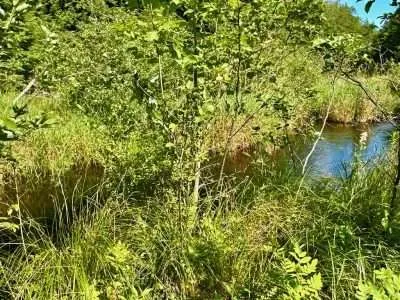
If your land is located near water bodies or has swampy areas, it may be within a wetland, flood zone, or floodplain, each affecting value differently:
- Wetlands: Areas covered or saturated with water, often with protected status under EPA and Army Corps of Engineers regulations
- Flood zones: FEMA-designated areas with varying flood risk levels, requiring special building considerations
- Floodplains: Areas next to rivers or streams that experience frequent flooding
Wetlands next to a creek bring diversity but often lower land values
Land in low-risk flood areas sees minimal value reduction, while high-risk zones and floodplains are valued significantly less. Wetlands can reduce buildable area and require permits under Section 404 of the Clean Water Act, though they may add value for specific uses like hunting land.
Utilities
Available utilities significantly impact land value, as installation costs can be substantial. The three main utilities affecting land prices are:
Power connections
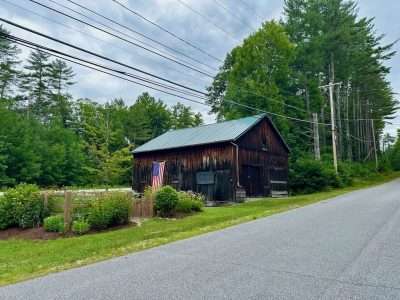
Nearby available power adds significant value to land
Land with existing power connections is more valuable than parcels requiring new line installation. Extending power lines, whether above-ground or underground, can cost thousands to tens of thousands of dollars depending on distance. Solar power systems offer an alternative for off-grid properties, though they require upfront investment.
Water access
Land connected to municipal or rural water systems commands higher prices. If water lines aren’t accessible, buyers face drilling costs ranging from $10,000 to $30,000 or more, depending on depth and local conditions. Some states like Colorado have restrictive well permit regulations that can further complicate water access.
Sewer and septic systems
Properties near municipal sewer lines have higher value due to convenience and lower installation costs. Rural land typically requires septic systems, which cost between $3,500 and $25,000 depending on system type, soil conditions, and local regulations.
Conventional septic systems with leach fields are the most affordable option but require soil that passes a percolation test. Properties with poor drainage may need more expensive aerobic or sand-filter systems. These utility considerations directly impact how much buyers are willing to pay for land.

Local market trends
Market conditions matter more than most sellers realize. In the Texas Hill Country, for example, our analysis of 5,797 transactions shows that volume dropped 44.7% from the 2022 peak while asking prices held flat, a sign that sellers are overpricing relative to demand. Mortgage rate changes can explain most of the buyer pullback, and the effect varies dramatically by region and price point.
Type of land and land use
Lastly, the value of your land is heavily impacted by the “highest and best use” of the land you have. This is basically a concept on how a property can be used to maximize its value.
For example, there will be a difference in price between land ideal for commercial, industrial, residential, recreational or agricultural uses. You’ll want to factor in whether or not your land is farmable, tillable, or either has existing timber or can easily be cultivated into timberland.
Commercial land is typically going to be the most valuable, with industrial coming in right up at the top as well. Farmland with good soil that can support crops is highly valuable, and has been on a tear in recent years with institutional funds investing in it.
How to Accurately Estimate Land Value
Most people start by pulling comps, and that’s the right move. Your county assessor’s office keeps records of every land transaction. Sites like Zillow and LandWatch show what’s actively listed. Find three to five parcels within 10-20 miles of yours that are similar in size, zoning, and road access. If the comps are recent and local, that’s more useful than any formula or calculator output.
The hard part with vacant land is that it doesn’t trade nearly as often as houses. In a rural county you might find one comparable sale from two years ago, 30 miles away. That’s a guess, not a comp. When that happens, you have two options: pay $300 to $700 for a licensed appraiser who’ll dig deeper into adjustments and income potential, or request a cash offer from a land buyer like us at no cost. An appraisal makes sense when you need a defensible number for estate planning, bank financing, or court proceedings. For a straightforward sale, a direct cash offer gets you a real number faster and for free.
One thing worth knowing: a real estate agent trying to win your listing might offer a free market analysis, but those valuations can lean high. If the number actually matters for a legal or financial decision, use a licensed appraiser with no stake in whether you sell.
How Much Is Cropland vs. Pasture Worth Per Acre?
The USDA tracks three land value categories, and the gaps between them are bigger than most people expect. Cropland averages $5,830 per acre nationally. Pasture sits at $1,920. That’s roughly a 3x difference, and knowing which category your land falls under changes any starting estimate significantly.
| State | Farm Real Estate | Cropland | Pasture |
|---|---|---|---|
| Texas | $2,970 | $2,710 | $2,300 |
| New York | $4,300 | $4,010 | $1,950 |
| Ohio | $9,350 | $9,750 | $4,150 |
| Georgia | $4,720 | $4,520 | $4,900 |
| Alabama | $4,150 | $4,550 | $3,400 |
| Michigan | $6,800 | $6,350 | $3,100 |
| Tennessee | $6,150 | $6,050 | $5,600 |
| North Carolina | $5,470 | $5,360 | $6,050 |
| Arkansas | $4,250 | $3,720 | $3,370 |
| Oklahoma | $2,540 | $2,470 | $2,100 |
| Indiana | $8,850 | $8,250 | $2,790 |
| Florida | $8,700 | $10,550 | $7,400 |
| California | $13,700 | $17,940 | $4,080 |
| Iowa | $9,790 | $10,300 | $3,650 |
Put it this way: 20 acres of pasture in Ohio, going by USDA averages, puts you around $83,000. If those same 20 acres are cropland, it jumps to $195,000. The type of land you own is one of the single biggest factors in what it’s worth.
How much is an acre of land worth in each US state?
When I get asked, “What is my land worth?” or “How much is my land worth per acre,” I always mention that land prices per acre in the US vary wildly. We’ve sourced the data used in the table below from the 2025 Land Values Summary (PDF), published by the United States Department of Agriculture (USDA). Just another note – this is an average value of farm real estate in each state in 2025, and the prices within states and based on all the above factors vary greatly.
Overall, the average farm real estate value per acre in the US is $4,350, with cropland averaging $5,830 and pasture at $1,920. There’s a wide range of prices across states affecting these averages.
What is the average acre of land worth in the 10 most expensive states?
- Rhode Island – $22,500 per acre
- New Jersey – $16,600 per acre
- Massachusetts – $14,900 per acre
- Connecticut – $14,400 per acre
- California – $13,700 per acre
- Iowa – $9,790 per acre
- Maryland – $9,750 per acre
- Delaware – $9,550 per acre
- Ohio – $9,350 per acre
- Illinois – $8,930 per acre
The most expensive land prices are mainly found in the northeast with the major economic centers like Washington D.C., Boston, and New York City. The midwest also ranks up there with the most expensive land which has the most productive farmland in the world. The competition for buying and selling land in these areas are fierce.
What state has the cheapest land per acre in the United States?
- New Mexico – $725 per acre
- Wyoming – $1,000 per acre
- Nevada – $1,200 per acre
- Montana – $1,230 per acre
- Colorado – $2,290 per acre
- North Dakota – $2,360 per acre
- Oklahoma – $2,540 per acre
- South Dakota – $2,970 per acre
- Texas – $2,970 per acre
- Kansas – $3,100 per acre
The least expensive land prices by state in the US are more random compared to the most expensive states. However, you’ll often find cheaper prices in the western US compared to the northeast.
This is due to a variety of factors including the prevalence of western desert land, landlocked and off-the-grid parcels, and other land that’s more difficult to build. Of course, this will depend on the specific area within a particular state. To determine land price per acre by zip code, you are typically going to need to look at listings in the specific area or a tool like our land value estimator by zip code. We suggest both.
Our estimator works at the county level, not by specific address. That’s intentional. Vacant land doesn’t sell often enough in most zip codes to build a reliable estimate from, but but USDA survey data at the county level gives a solid baseline range. The tool adjusts for parcel size too, which makes a bigger difference than most people expect.
For the tightest read on your specific parcel, use the estimator as a starting point, then check what similar land has actually listed or sold for nearby on Zillow or LandWatch. Seeing both what sellers are asking and what buyers are paying gives you the clearest picture.
Here’s our full list of average land prices by state:
| State | Average value per acre | YoY Change |
|---|---|---|
| Rhode Island | $22,500 per acre | +2.3% |
| New Jersey | $16,600 per acre | +2.5% |
| Massachusetts | $14,900 per acre | +4.2% |
| Connecticut | $14,400 per acre | +0.7% |
| California | $13,700 per acre | +2.2% |
| Iowa | $9,790 per acre | +3.9% |
| Maryland | $9,750 per acre | +3.0% |
| Delaware | $9,550 per acre | — |
| Ohio | $9,350 per acre | +6.7% |
| Illinois | $8,930 per acre | +2.6% |
| Indiana | $8,850 per acre | +4.0% |
| Florida | $8,700 per acre | +4.8% |
| Pennsylvania | $8,490 per acre | +4.0% |
| Michigan | $6,800 per acre | +7.8% |
| Minnesota | $6,790 per acre | +5.3% |
| New Hampshire | $6,500 per acre | +4.0% |
| Wisconsin | $6,420 per acre | +4.9% |
| Tennessee | $6,150 per acre | +7.7% |
| Virginia | $6,100 per acre | +4.3% |
| Kentucky | $5,480 per acre | +3.4% |
| North Carolina | $5,470 per acre | +5.4% |
| Missouri | $5,000 per acre | +4.2% |
| South Carolina | $4,740 per acre | +5.3% |
| Georgia | $4,720 per acre | +4.9% |
| Idaho | $4,580 per acre | +4.3% |
| Vermont | $4,400 per acre | +1.1% |
| New York | $4,300 per acre | +3.6% |
| Arkansas | $4,250 per acre | +3.4% |
| Nebraska | $4,250 per acre | +4.2% |
| Arizona | $4,180 per acre | +4.5% |
| Alabama | $4,150 per acre | +3.8% |
| Louisiana | $3,850 per acre | +3.5% |
| Oregon | $3,780 per acre | +1.6% |
| Washington | $3,710 per acre | +2.5% |
| Mississippi | $3,580 per acre | +2.6% |
| West Virginia | $3,520 per acre | +2.9% |
| Utah | $3,500 per acre | +6.1% |
| Maine | $3,350 per acre | +2.8% |
| Kansas | $3,100 per acre | +4.4% |
| Texas | $2,970 per acre | +6.1% |
| South Dakota | $2,970 per acre | +6.8% |
| Oklahoma | $2,540 per acre | +5.8% |
| North Dakota | $2,360 per acre | +4.4% |
| Colorado | $2,290 per acre | +4.1% |
| Montana | $1,230 per acre | +2.5% |
| Nevada | $1,200 per acre | +4.3% |
| Wyoming | $1,000 per acre | +2.6% |
| New Mexico | $725 per acre | +3.6% |
How much is 10 acres of land worth? How much is 80 acres?
All things considered, the average price per acre of a 10 acre piece of land is going to be worth more and sell for more per acre than a larger 80 acres of land. Think of land similar to a 12 pack of Keystone vs. buying a can individually. When you buy in bulk, you can typically get it at wholesale prices, but buying individually is more expensive per acre.
If an online estimate or cash offer isn’t enough for your situation, here’s what a formal appraisal looks like.
Professional Appraisal Methods
If you need a valuation that holds up in court, with a bank, or for tax purposes, a professional appraiser will use one of four established methods. The most common for vacant land is the sales comparison approach, the same comp-based method described above, except the appraiser handles the adjustments and signs off on the number.
Cost Approach
This one estimates what it would cost to acquire similar raw land and reproduce any improvements on it. Appraisers lean on it more for improved properties than bare ground, but it fills the gap when comparable sales are hard to come by in your county.
Income Capitalization Approach
If your land generates income through farming leases, hunting leases, timber harvesting, or a cell tower agreement, the appraiser calculates value based on that income stream. Stable, documented income pushes the number up. Informal handshake leases? Not so much. This method matters most for ag and recreational land where the income is the whole point of ownership.
Extraction Method
The appraiser takes the sale price of an improved property and subtracts the depreciated value of the buildings to isolate the land value underneath. Think of it as reverse engineering. It’s a workaround for areas where vacant parcels almost never change hands.
Pros and Cons of Using Realtors and Appraisers
A licensed appraiser gives you a number that banks, courts, and the IRS will accept. If you’re dealing with estate planning, a divorce settlement, or financing a purchase, that’s the route to take. Expect to pay $300 to $700 for vacant land, and the report usually takes 2-4 weeks. You’re paying for a snapshot that starts aging the day it’s delivered, but for legal and financial decisions, nothing else carries the same weight.
Realtors know what’s moving in your market right now. They see the listings and the offers, not just closed sales data, and a good agent can handle the entire sale process if you decide to list. The catch is commission, typically 5-6% of the sale price. A “free” market analysis from an agent comes with an incentive to price high enough to win your listing. That doesn’t make it useless, but keep it in mind when you’re comparing numbers. Of course, if you don’t want to spend money or sign anything, a direct cash offer from a land buyer gets you a real number in a couple days.
What Moves the Number Most
Zoning and infrastructure will move your land’s value more than almost anything else on this page. Residential or commercial zoning can put a parcel at multiples above what USDA ag averages suggest. Water, sewer, and electric at the property line add real dollar value, sometimes tens of thousands. A landlocked parcel with no legal road access? That’s a completely different sale than one with county road frontage, even if the acreage and location are identical.
Best approach: run the estimator, pull your own comps, and get at least one outside opinion. If those three numbers land in roughly the same range, you’ve got your answer.
Frequently Asked Questions About Land Values
How accurate is a land value estimator?
Good enough to know if you’re in the right neighborhood, not precise enough to make a deal on. The range is solid because it’s built on USDA survey data at the county level, but road access, zoning, and recent nearby sales can push the real number well above or below. For a tighter figure, a professional land appraisal runs $300 to $700.
What is the average price per acre of land in the United States?
According to the USDA’s 2025 report, the national farm real estate average is $4,350 per acre. Cropland runs higher at $5,830. Pasture and grazing land averages $1,920. The range across states is massive: $725 in New Mexico up to $22,500 in Rhode Island.
Why did land values go up in 2025?
4.3% nationally in 2025. More buyers than sellers, limited inventory, and interest rates that came down enough to keep demand strong. Michigan jumped 7.8%, Tennessee 7.7%, South Dakota 6.8%.
How do I find out what my specific parcel is worth?
Honestly, the fastest path is to request a cash offer from a buyer who knows your market. We typically turn those around in 2 business days, no cost. If you want to do your own homework first, pull comparable sales from your county assessor’s office or check Zillow and LandWatch. A professional appraisal ($300-$700) is the most precise option but takes longer and costs money.
Does land type affect value per acre?
Significantly. Cropland runs about 3x the value of pasture nationally ($5,830 vs. $1,920 per acre). Irrigation matters too. In Texas, irrigated cropland averages $3,380/acre compared to $2,620 for non-irrigated. Residential-zoned land near population centers can be multiples above any of these USDA agricultural numbers.
What state has the cheapest land per acre?
New Mexico, $725 per acre. Wyoming, Nevada, and Montana are all under $1,250. Arid rangeland with limited ag use across the board.
Ready to Find Out What Your Land Is Worth?
You’ve seen the USDA averages. You’ve compared your state, your county, your land type. Now get an actual number.
Here’s how it works:
- Tell us about your property: state, county, acreage, and how to reach you.
- We dig into recent sales, tax records, and current market conditions in your area.
- You get a no-obligation cash offer within 2 business days.
- If the number works, we can close in as little as 3-4 weeks.
We buy land across the country, and we’ll give you a straightforward cash offer for your property. No agent fees, no listing, no waiting months for a buyer.
Data sources: State-level values from the USDA Land Values 2025 Summary. County-level calculator estimates derived from USDA Census of Agriculture (2022) survey data, scaled to 2025 using state-level USDA Land Values Survey growth rates. USDA values are statistical estimates based on operator surveys, not recorded sale prices.
